
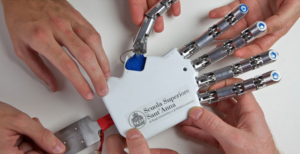
The Artificial Hands Area (AHA) of the BioRobotics Institute pursues research in mechatronics and human-machine interfaces with the goal of developing advanced robotic limbs to be used as thought-controlled prostheses. The principal investigator of the AHA is Prof. Christian Cipriani.
Current research topics include: the (high-tech) observation of the human hand, the design of artificial sensory system; the design of artificial hands, digits, wrists and elbows, their transmission and artificial sensory system; the design of control architectures and intuitive control strategies; the use of biological signals for the physiological control of prehension; the development and clinical validation of bidirectional non-invasive (wearable) interfaces through novel assessment tools; the investigation and comparison of shared-control strategies between user and the prosthesis; the incorporation of sensory feedback strategies into one’s sensorimotor control.
The Artificial Hands Area spun out Prensilia, a company that develops and commercializes artificial hands worldwide, since 2009.
The Artificial Hands Area includes the Human-Robot-Interaction Laboratory (HRI), coordinated by Dr. Marco Controzzi, the Textile Robotics Lab, coordinated by Dr. Leonardo Cappello and the REPAIR Lab (Rehabilitation Engineering and Prosthetics Applied Innovation & Research). The HRI Lab develops robust artificial tactile sensors, human-robot interaction, design of mechanisms for a safe and efficient interaction between robot and human. The Textile Robotics Lab conducts research in the fields of materials technology, human-machine interfaces, and soft robotics for the development of robotic systems based on functional textile materials. The REPAIR Lab results from a collaboration with INAIL Prosthetic Center. The objective is to bridge the engineering research and development with the rehabilitation activities conducted by physicians and therapists in direct contact with the patients.
For more info download the leaflet.
Current project involved:
- Motu++:The partners of the project are The BioRobotics Institute of Scuola Superiore Sant’Anna, University of Bologna, Polytechnic University of Milan, Fondazione Don Gnocchi and INAIL Prosthesis Center. The aim of the project is the development of a new generation of lower-limb prostheses for people with a lower extremity amputation.
- MIO-PRO: jointly carried out by the Regenerative Technologies Lab, coordinated by Leonardo Ricotti, and the Artificial Hands Area, coordinated by Christian Cipriani, in synergy with the research unit of the INAIL Prosthesis Center, coordinated by Emanuele Gruppioni, it aims to develop a new human-machine interface for the control of prostheses.
- ReGiveMe5: it is focused in developing new bionic surgery procedures for adapting the amputee’s body to the most innovative prostheses and restore proprioception.
- WiFi-MyoHand: funded by INAIL, the project aim to developing and testing an upper limb prosthetic system consisting of an implatable sensory feedback return system capable of allowing a more intuitive and selective control of the prosthetic lib.
- Fit4MedRob: Fit for Medical Robotics aims to revolutionize current rehabilitation and assistive models for people of all ages with reduced or absent motor, sensory, or cognitive functions, an initiative of the Ministry of University and Research, Directorate General for Research.
- Bio Arm: promoted by INAIL, it aims to develop an innovative and completely portable upper-limb active orthosis, for patients having brachial plexus injury.
- B-CRATOS, The B-CRATOS system features a battery-less, fully-implantable brain interface capable of sensing high-resolution neural signals and precisely stimulating cortical targets. This project has received funding from the European Union’s Horizon 2020 research and innovation programme.
- APRIL: funded by the European Commission under the Horizon 2020 framework programme for Research and Innovation, (multipurpose robotics for mAniPulation of defoRmable materIaLs in manufacturing processes) is developing autonomous, dexterous and market-oriented robot prototypes to innovate the manufacturing of flexible and deformable materials in European enterprises.
- FAST: “Fusing Amputation Surgeries with prosthetic Technologies”) focuses on the development of advanced upper-limb prosthetics and related methodologies for intuitive control using myokinetic interfaces.
Past project involved:
- DeTOP (Dexterous Transradial Osseointegrated Prosthesis with neural control and sensory feedback): Research and Innovation project funded by European Commission. It aims to develop and clinically implement robotic, sensing and long-term interfacing technologies for the next-generation transradial prosthesis;
- CECA 2020: National Research project funded by INAIL and focused on the development and experimental evaluation of novel non-invasive upper limb prostheses and components.
Follow all research activities on our YouTube Channel.