MYKI tackles a set of scientific (SO) and/or technological (TO) objectives. Our goal is to obtain results of scientific relevance according to the development of the project.
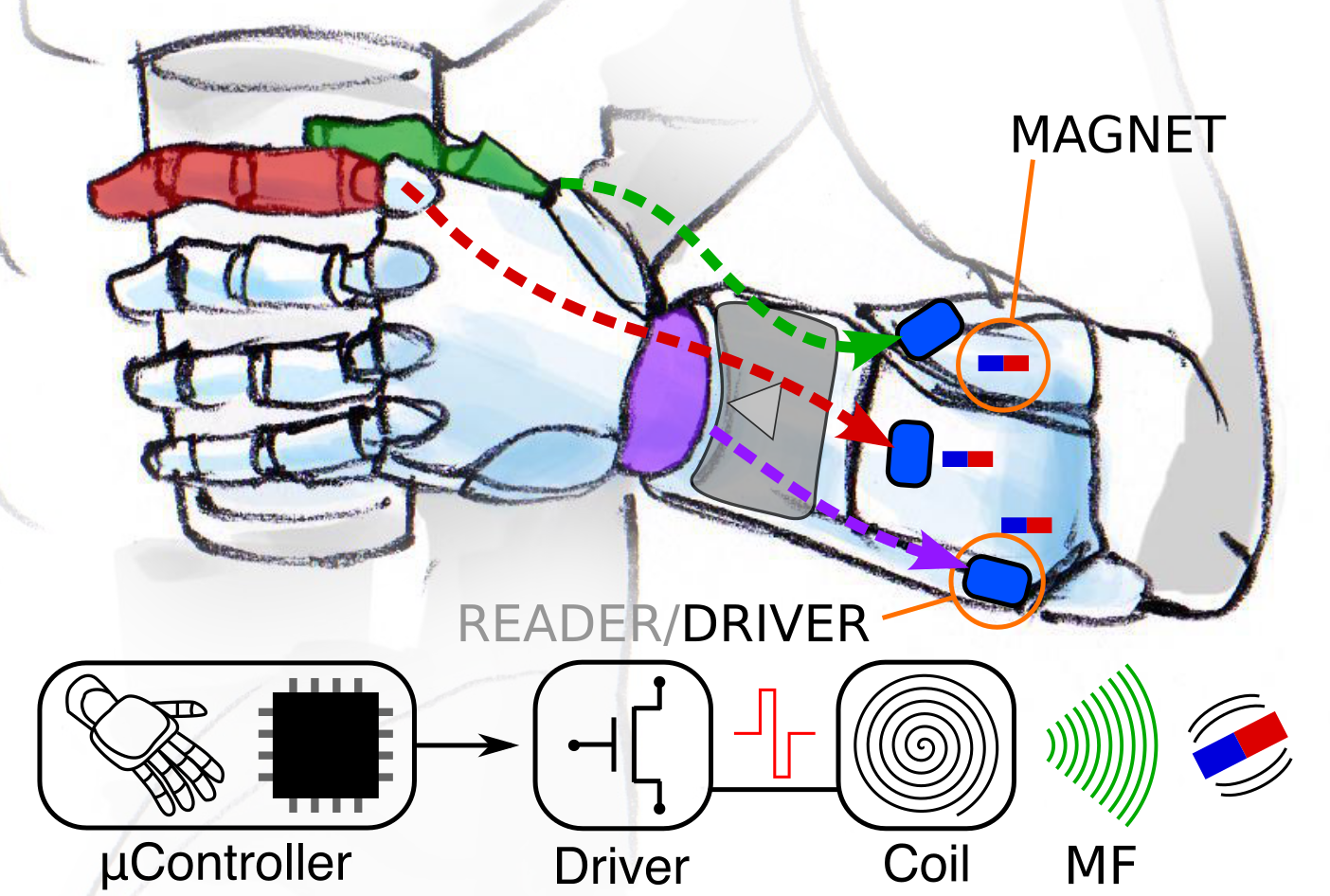
The development of a magnet localizer (or reader) is the pivotal enabling technology for MYKI. The idea is quite straightforward: if one or multiple magnets are implanted within different muscles they will travel in accordance with their natural elongation or contraction. The real-time localization of the position of the magnets would provide a direct measure of muscles contraction, which gives a compound information of the position of the joint and force applied by the muscle itself. Such information could be used to control the force/position of the relative degree of freedom (DoF) in a hand prosthesis.
RESULTS
The results of this technological objective are presented in:
“Localization accuracy of multiple magnets in a myokinetic control interface”. The results of this work suggest geometrical relationships of the inter-magnet distance and the distance to the sensor plane, which, if respected, ensure an accurate localization of an indefnitely high number of magnets.
“The Myokinetic Control Interface: How Many Magnets Can be Implanted in an Amputated Forearm? Evidence From a Simulated Environment”. In this work, simulation studies unveiled the geometrical rules to follow when placing the magnets inside the muscles, providing relevant guidelines for the surgeon to carry out the implant.
“To what extent implanting single vs pairs of magnets per muscle affect the localization accuracy of the myokinetic control interface? Evidence from a simulated environment”. The authors investigated the pros and cons of implanting one (i) or two (ii) magnets per muscle both under ideal and mechanically disturbed conditions (i.e. shift of the sensor grid).
“Myokinetic prosthesis control oriented environmental magnetic disturb analysis”. The authors investigated the robustness and accuracy of the myokinetic interface against external disturbance in presence of domestic electromagnetic emissions (e.g. a microwave oven).
“Development of an Embedded Myokinetic Prosthetic Hand Controller”. The work presents dedicated hardware solutions suitable for integration on wearable devices
“Data-Driven Real-Time Magnetic Tracking Applied to Myokinetic Interfaces”. The authors employed machine learning models, namely linear and radial basis functions artificial neural networks, to translate measured magnetic information into desired commands for active prosthetic devices.
“Comparison of online algorithms for the tracking of multiple magnetic targets in a myokinetic control interface”. The authors investigated the performance of three localization algorithms in tracking up to 9 magnets: two optimization-based (Levenberg-Marquardt algorithm, LMA, and Trust Region Reflective algorithm, TRRA) and one recursion-based (Unscented Kalman Filter, UKF).
“Feasibility Study on Disentangling Muscle Movements in TMR Patients Through a Myokinetic Control Interface for the Control of Artificial Hands”. The authors preliminary tested the myokinetic interface non-invasively with TMR patients, including a first effort to associate the localization outcomes to the user’s intention.
“The myokinetic control interface: tracking implanted magnets as a means for prosthetic control”, published on Scientific Reports.
The paper demonstrated the feasibility of the MyoKinetic approach by means of a forearm mockup, designed to replicate the anatomical location and contraction movements of extrinsic muscles of the hand. In particular, the authors demonstrated the possibility of monitoring the contraction of four “artificial muscles” and used this information to control the movements of the fingers of a prosthetic hand independently.
“Development of an Embedded Myokinetic Prosthetic Hand Controller” published in Sensors. This study presents an embedded system based on 32 magnetic field sensors and a real time computation platform. These results proved for the first time the viability of using an embedded system for magnet localization.
Video from: S. Tarantino, F. Clemente, D. Barone, M. Controzzi, C. Cipriani, “The myokinetic control interface: tracking implanted magnets as a means for prosthetic control,” Scientific Reports, vol. 7, no. 17149, pp. 1-11, 2017 – Download paper
The development of a magnet remote actuator (or driver) is the second enabling technology for MYKI. This is required for providing sensory feedback to the individual. The idea is to embed within the prosthetic socket coils (or electromagnets), able to generate a controllable, external magnetic field, large enough to interact with the implanted permanent magnets. In this way, the interaction forces will produce forces in the implanted magnet and such internal forces could be sensed by sensory receptors in the muscles. If these stimuli are perceived by the individual, the magnet will behave as a bi-directional HMI.
RESULTS
“Proprioceptive Augmentation With Illusory Kinaesthetic Sensation in Stroke Patients Improves Movement Quality in an Active Upper Limb Reach-and-Point Task”. The authors demonstrated that non-invasive proprioceptive feedback induced through 90Hz vibrations can be fruitfully integrated into rehabilitation approaches for stroke patients.
“The myokinetic stimulation interface: activation of proprioceptive neural responses with remotely actuated magnets implanted in rodent forelimb muscle”. The authors demonstrated the feasibility to elicit proprioceptive neural responses with remotely actuated magnets implanted in rodent forelimb muscles.
“Feasibility of generating 90 Hz vibrations in remote implanted magnets”. The authors demonstrated the possibility to induce linear (force) and torsional (torque) vibrations in one out of many magnets, at arbitrary frequencies (1-90Hz) and with high directionality, as well as with different vibration shapes.
Specific efforts will be dedicated for investigating the kind of forearm muscle contractions (e.g. concentric, isometric vs. isotonic) we can expect in a transradial amputee. In fact, the amputation surgery is generally unplanned and is frequently affected by other clinical factors. The result is a complex anatomical condition of the residual muscles within the amputated limb. For this reason, it is necessary to understand how to use the magnetic localization signal to control the physiologically appropriate movements in the prosthesis. While direct control represents the golden standard, pattern recognition or other bio-inspired algorithms could also be applied.
RESULTS
“Classification of Transient Myoelectric Signals for the Control of Multi-Grasp Hand Prostheses” is a study by Gunter Kanitz, Christian Cipriani and Benoni B. Edin published on IEEE Transactions on Neural Systems and Rehabilitation Engineering (July 2018).
The paper proposes an approach that relies on decoding the intended grasp from forearm EMG recordings associated with the onset of muscle contraction as opposed to the steady-state signals.
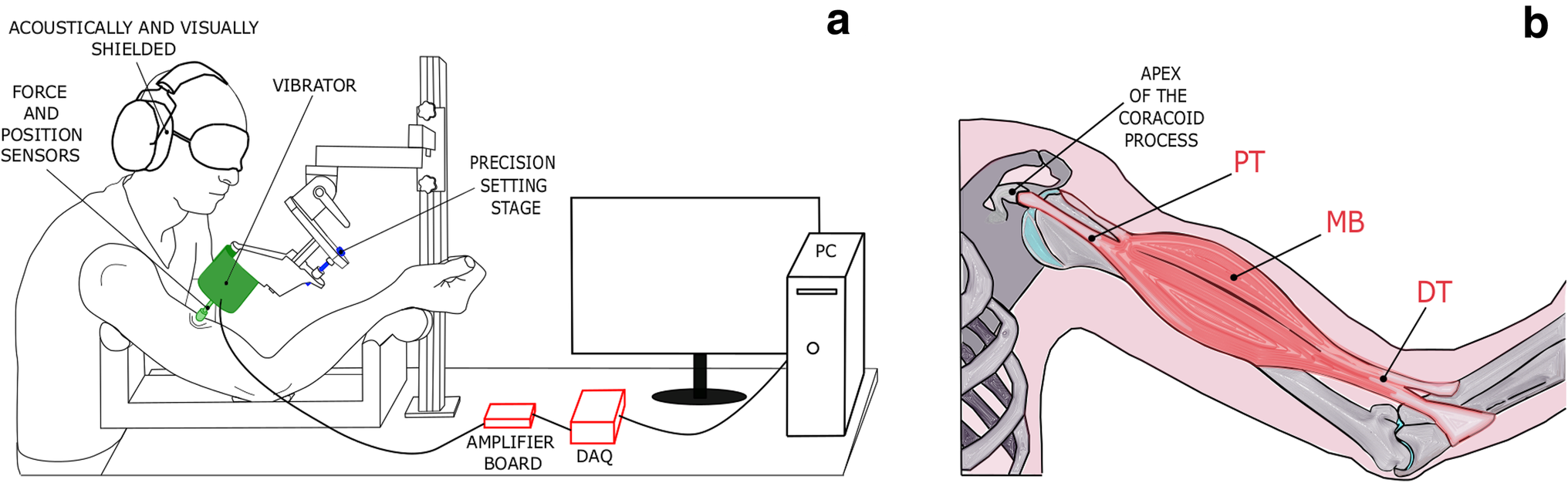
MYKI aims to investigate for the first time, the psychophysical perception of a mechanical stimulus provided intramuscularly. Several types of sensory receptors lie within skeletal muscles: muscle spindles, the Golgi tendon organs and free nerve endings. Hence, achieving TO2 the force produced within the muscles is likely to be sensed by such receptors.
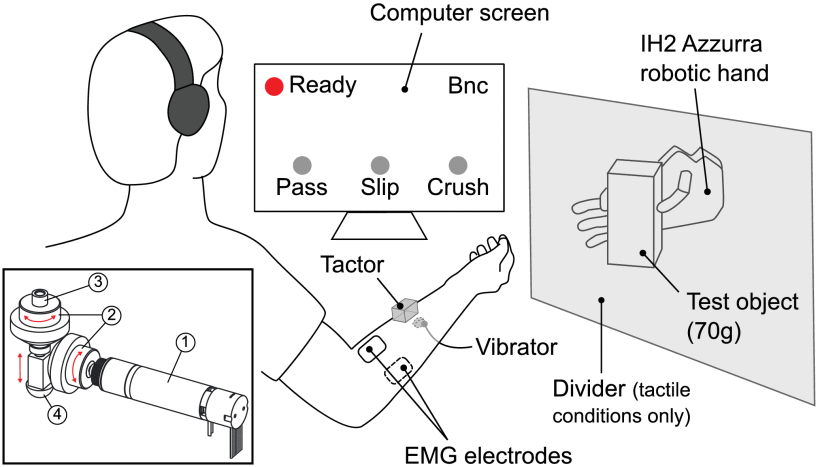
Besides how the stimulus is perceived, touch information will be provided according to the Discrete Event-driven Sensory feedback Control (DESC) policy, which posits that motor tasks in humans are organized in phases delimited by means of sensory encoded discrete mechanical events. If these mechanical events are signalled to the brain artificially, e.g. using short-lasting mechanical stimuli, individuals can rapidly integrate such information in their sensory motor control even if the stimuli use a different modality.
RESULTS
From this scientific objective, MYKI project has published three papers:
- F. Ferrari, F. Clemente, C. Cipriani, “The preload force affects the perception threshold of muscle vibration-induced movement illusions”, Experimental Brain Research (October 2018).
- M. Aboseria, F. Clemente, L. F. Engels, C. Cipriani, “Discrete Vibro-Tactile Feedback Prevents Object Slippage in Hand Prostheses More Intuitively Than Other Modalities”, IEEE Transactions on Neural Systems and Rehabilitation Engineering (Vol. 26, Issue 8, August 2018).
- A. W. Shehata, L. F. Engels, M. Controzzi, C. Cipriani, E. J. Scheme, J. W. Sensinger, “Improving internal model strength and performance of prosthetic hands using augmented feedback”, Journal of NeuroEngineering and Rehabilitation 2018 (July 2018).
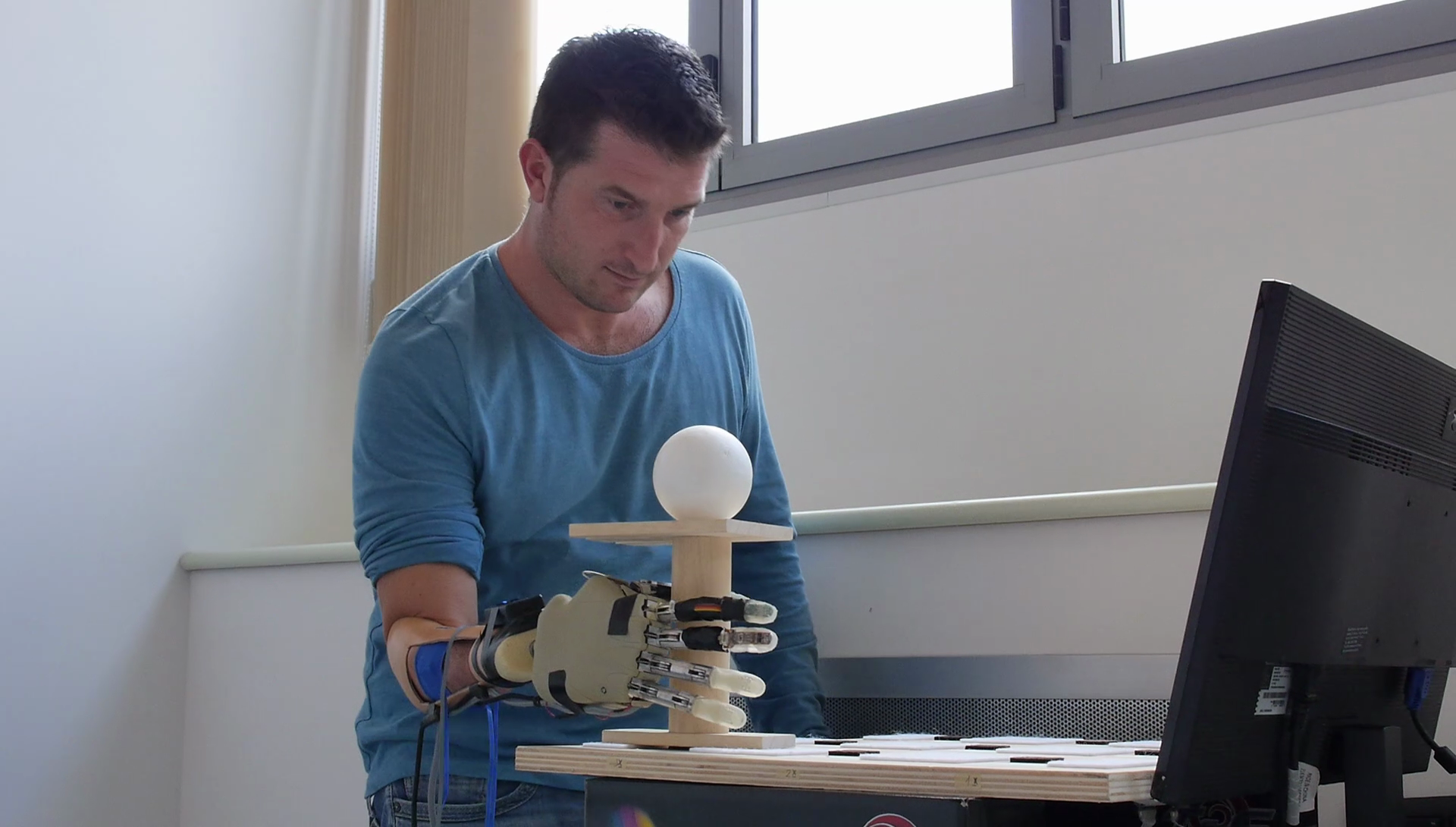
The development of a suitable physical prosthesis with controllable actuators in the hand (digit movements) and in the wrist is one of the technological goals of the project. The prosthesis will include an appropriate number of motorized DoFs for testing the performance of the control interface, as well as tactile and proprioceptive sensors for assessing the feedback part.
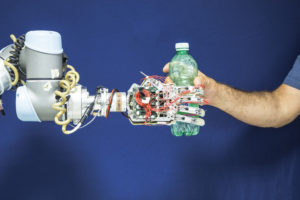
In this context, MYKI will also investigate the perception of external agents while interacting with the prosthetic hand (and the individual wearing it). In particular, the studies will be focused on object handover, probably the most basic collaborative motor tasks between humans.
RESULTS:
“Compliant Prosthetic Wrists Entail More Natural Use Than Stiff Wrists During Reaching, Not (Necessarily) During Manipulation”, published on IEEE Transactions on Neural Systems and Rehabilitation Engineering, demonstrates the functionality of a compliant prosthetic wrists in the development of artificial arm with functions equivalent to those of the human arm.
“Humans adjust their grip force when passing an object according to the observed speed of the partner’s reaching out movement” published on Experimental Brain Research, contributes understanding of the roles of sensory input in the strategy that empower humans to perform smooth and safe handovers, and they suggest methods for programming controllers that would enable artificial hands to hand over objects with humans in an easy, natural and efficient way.
“A 2-Degree-of-Freedom Quasi-Passive Prosthetic Wrist With Two Levels of Compliance”. The authors designed a new wrist capable of automatic transitions between a compliant mode and a stiff mode, such that the wrist is compliant during reaching and stiff during manipulation.
MYKI aims to clinically assess the newly defined MyoKinetic interface in one selected volunteer with a transradial amputation, by implanting in his/her forearm muscles magnets for a period of up to a month. Magnets themselves are not biocompatible. However, some magnet manufacturers offer coatings and plating that are biocompatible, such as Parylene and titanium. Therefore, specific efforts will be dedicated to verify the biocompatibility and the biostability of implanted magnets.
RESULTS
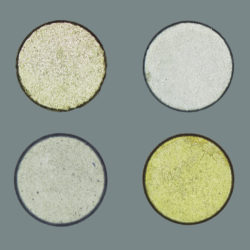
“Stability and in vivo safety of gold, titanium nitride and parylene C coatings on NdFeB magnets implanted in muscles towards a new generation of myokinetic prosthetic limbs”. Through in vitro and in-vivo tests, the authors investigated the biocompatibility of three different coating materials for the magnets, namely Gold, Titanium Nitride, and Parylene C.